Peathumus is one ingredient with ten thousand years behind it. Here is where it comes from, what is inside it, and what researchers are learning about humic and fulvic substances and the gut.*
10,000Years to form
100xConcentrated
1 gPer day
10Studies cited below
01The source
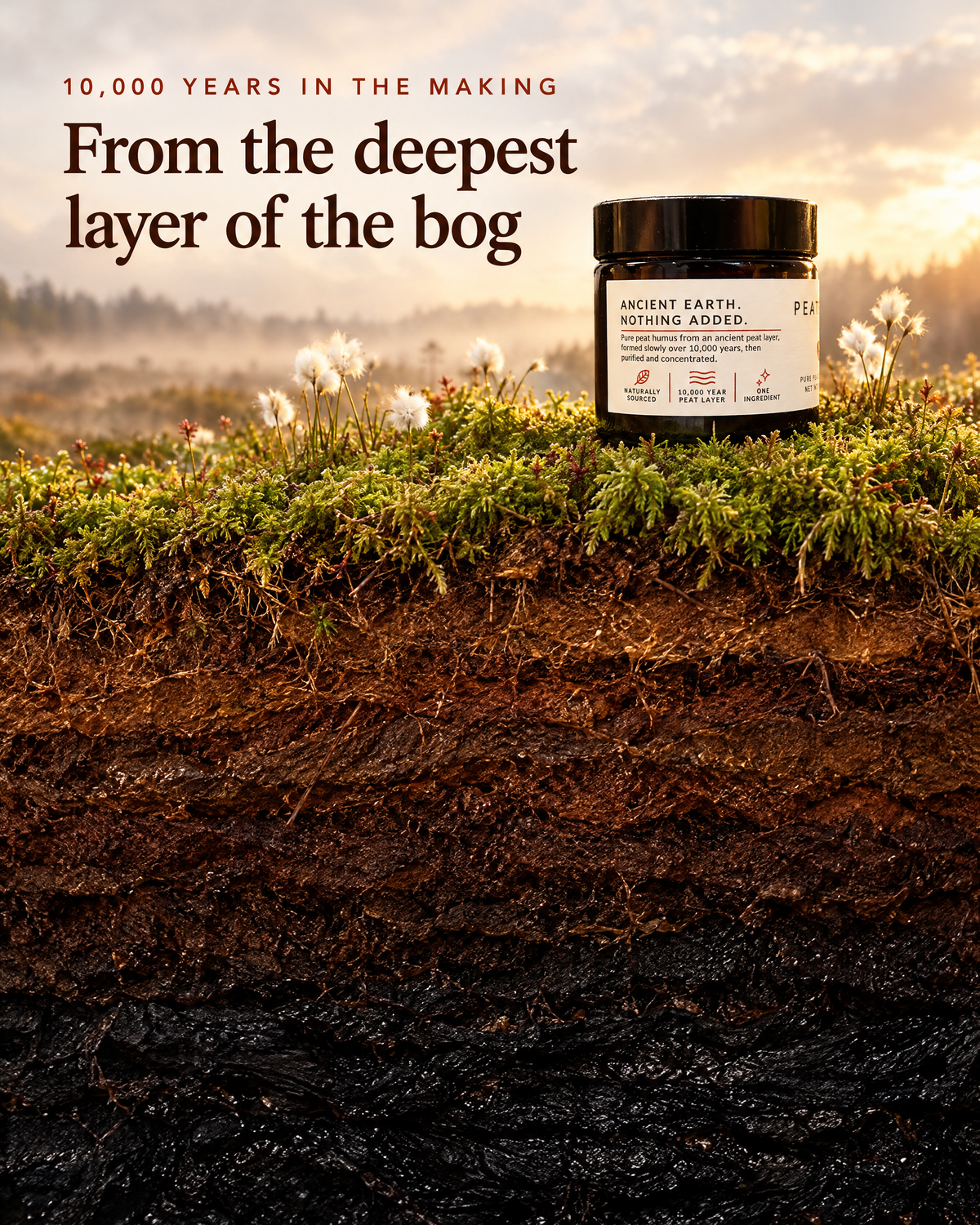
The deepest layer of a northern bog
Peat bogs build up in layers. New plant matter grows at the surface, and everything below it is slowly buried, waterlogged and cut off from oxygen. In that cold, acidic, oxygen-free environment, microbes work extremely slowly, and plant matter is transformed into humus over thousands of years.
Peathumus comes from the very bottom of the catotelm, the oldest layer of the bog at about 5,000 to 10,000 years old. That is where the transformation is most complete: dense, dark, fully decomposed humus, naturally rich in humic substances, fulvic substances and trace minerals.
Peat humus is not a blend of isolated ingredients. It is one whole material that naturally carries all three.
Humic substances
Large, complex organic molecules formed as plant matter breaks down over millennia. Researchers study them for their antioxidant activity, their ability to bind minerals and other compounds, and how they interact with gut bacteria.*
Fulvic substances
The smaller, lighter fraction of humus. Fulvic molecules dissolve easily in water and are studied for their role in carrying nutrients. Our extraction is designed to concentrate them.*
Trace minerals
Generations of plants grew, died and decomposed into the same layer, so minerals accumulated in the humus over thousands of years. Nothing isolated, nothing added back in.*
03Your gut
How humic substances meet your microbiome*
Your gut is home to trillions of bacteria that help digest food, make use of nutrients and keep the gut lining healthy. What you feed them shapes which ones thrive.
Researchers are studying humic substances in three main ways that matter for the gut:
Feeding the microbiome*In a study of healthy adults, humic acids increased the overall amount of bacteria in the colon.
Antioxidant activity*Humic acids from peat show strong antioxidant activity in lab tests, and it varies with the peat's source and depth.
Binding*Humic substances are known for binding minerals, metals and other compounds, which researchers are exploring in the digestive tract.
04The research
Read the studies yourself
Every study below is published and linked, so you can read it in full. We label each one by type, because a study in people means something different from a lab test.
Human Study in peopleAnimal Study in animalsLab Test-tube studyReview Summary of many studies
Human · 2017
Humic acids increased gut bacteria in healthy adults
14 healthy volunteers took a humic acid preparation for 45 days. The total amount of bacteria in their colon rose and stayed higher through the end of the study, while each person's own mix of bacteria stayed stable. A small study without a placebo group.
Swidsinski A, Dörffel Y, Loening-Baucke V, et al. Impact of humic acids on the colonic microbiome in healthy volunteers. World Journal of Gastroenterology. 2017;23(5):885–890. Read the studyLab · 2018
Humic acids from peat showed strong antioxidant activity
Researchers isolated humic acids from nine different peat samples. Several showed strong antioxidant activity, neutralising up to about 95% of free radicals in a standard test, and the results depended on where and how deep the peat came from.
Zykova MV, Schepetkin IA, Belousov MV, et al. Physicochemical characterization and antioxidant activity of humic acids isolated from peat of various origins. Molecules. 2018;23(4):753. Read the studyAnimal · 2023
Humic acids shifted gut bacteria toward beneficial strains
In mice, humic acids added to drinking water increased Lactobacillus and Bifidobacterium, two well-known beneficial bacteria, and supported the proteins that hold the gut lining together.
Huang J, Xu P, Shao M, et al. Humic acids alleviate dextran sulfate sodium-induced colitis by positively modulating gut microbiota. Frontiers in Microbiology. 2023;14:1147110. Read the studyReview · 2015
How humic substances interact with the body's inflammatory response
A review of lab, animal and human research on humic substances and the body's normal inflammatory response, including a summary of the safety data in people.
Jansen van Rensburg CE. The anti-inflammatory properties of humic substances: a mini review. Phytotherapy Research. 2015;29(6):791–795. Read the studyReview · 2025
Humic and fulvic substances, from nature to health research
A recent review of humic and fulvic acids covering their antioxidant activity and their ability to bind metals and other compounds. The authors call for standardised extraction and more research in people.
Gvozdeva Y, Peneva P, Katsarov P. Biomedical applications of humic substances: from natural biopolymers to therapeutic agents. Antioxidants. 2025;14(9):1139. Read the studyReview · 2025
A full review of how humic substances work in the body
A comprehensive review of the research on humic substances, including their effects on the gut microbiome, their antioxidant activity and their safety profile.
Zykova MV, Trofimova ES, Azarkina LA, et al. Pharmacological effects of humic substances and their signaling mechanisms. Molecules. 2025;31(1):114. Read the study
These studies looked at humic and fulvic substances in general. They did not test Peathumus itself, and some used doses or forms different from ours.
05Peathumus vs shilajit
Older than shilajit. The superior choice.
Shilajit is the best-known fulvic-rich supplement. It is a dark resin that seeps out of mountain rock, mostly in the Himalayas, and it has been used in traditional medicine for thousands of years. Like peat humus, it forms from ancient plant matter and is rich in humic and fulvic substances. The difference is time: shilajit forms over centuries, while the Peathumus layer has been forming for up to 10,000 years.
Peathumus
Shilajit
Where it forms
The deepest layer of northern peat bogs
Seeps from cracks in mountain rock
Time to form
Up to 10,000 years
Centuries
What it carries
Humic substances, fulvic substances and trace minerals
Humic and fulvic substances, plant compounds and minerals
Consistency
One ingredient, concentrated 100x
Varies widely by region
Daily serving
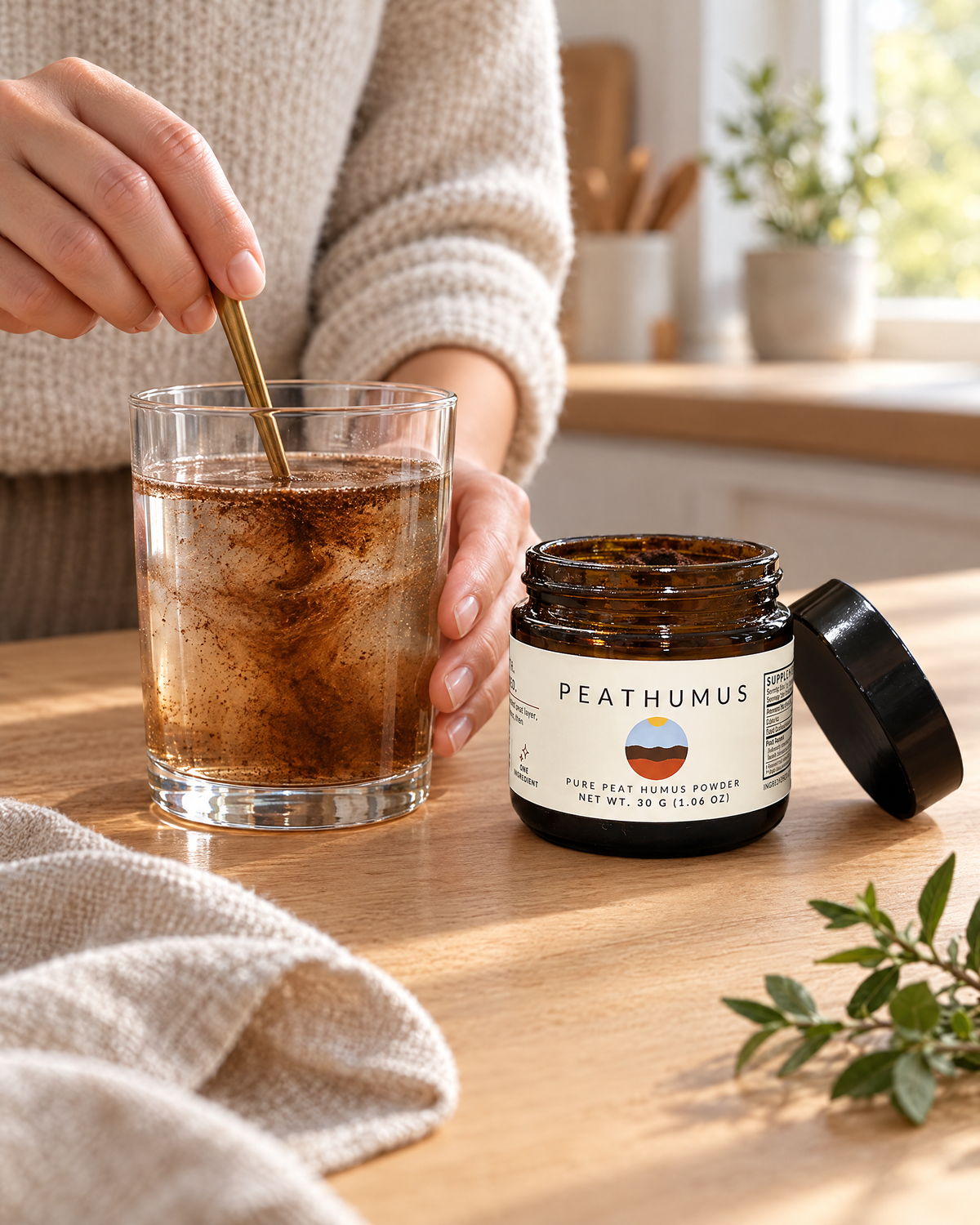
1 g powder
Usually 250–500 mg resin
What the research says about shilajit
Shilajit has its own body of research. These studies tested shilajit, not Peathumus, and we share them so you can see how fulvic-rich materials are being studied.
Review · 2007
What shilajit is
A review describing shilajit as a complex mix of humic substances and plant and microbial compounds that seeps from rock layers in mountain ranges, used for thousands of years as a traditional rejuvenator.
Agarwal SP, Khanna R, Karmarkar R, et al. Shilajit: a review. Phytotherapy Research. 2007;21(5):401–405. Read the studyHuman · 2019
Shilajit and muscle strength during hard exercise
63 active men took 250 mg or 500 mg of shilajit, or a placebo, for 8 weeks. Among the stronger half of the group, those on 500 mg lost less strength during a fatiguing workout than the other groups. The lower dose made no difference.
Keller JL, Housh TJ, Hill EC, et al. The effects of Shilajit supplementation on fatigue-induced decreases in muscular strength and serum hydroxyproline levels. Journal of the International Society of Sports Nutrition. 2019;16:3. Read the studyReview · 2019
Where shilajit's effects come from
A review linking shilajit's antioxidant and other reported activities mainly to its humic and fulvic acids, plant compounds and trace elements. The authors call for more safety testing and quality control.
Mishra T, Dhaliwal HS, Singh K, Singh N. Shilajit (Mumie): current status of biochemical, therapeutic and clinical advances. Current Nutrition & Food Science. 2019;15(2):104–120. Read the studyLab · 2026
Shilajit from different regions acts differently in the gut
Shilajit from Russia, Nepal and Iran was put through a simulated digestion. Each one affected gut bacteria such as Lactobacillus and Bifidobacterium differently, showing how much shilajit varies with where it comes from.
Kamgar E, Gumienna M, Górna-Szweda B, et al. From phenolic profile to gut function: comparative effects of region-specific Shilajit on selected culturable intestinal microbial groups and β-glucuronidase activity. Molecules. 2026;31(12):2172. Read the study
06Our process
From the bog to one gram
Nature takes ten thousand years. Our part is to get it to you as pure and concentrated as possible.
Harvest
Raw peat humus is ethically harvested in small batches from the deepest layer of northern bogs.
Extract
The humus is water extracted and filtered to separate the humic and fulvic substances.
Concentrate
It is concentrated 100 times compared with the raw humus, then purified.
Dry
Finally it is dried into one fine powder. No fillers, flavours or sweeteners.
Research on humic and fulvic substances is growing fast, and the early results are exciting. Most of it so far is in the lab and in animals, and large clinical trials in people are still to come. We built Peathumus around this emerging science, and we will keep adding new studies to this page as they are published.
Questions
Science FAQ
What is the difference between humic and fulvic substances?
Both form as plant matter decomposes. Humic substances are the larger molecules, and fulvic substances are the smaller, lighter fraction that dissolves in water at any pH. Peat humus naturally contains both.
Why the deepest layer of the bog?
The deeper the layer, the longer it has spent transforming without oxygen. The bottom of the catotelm is the oldest and most fully decomposed humus in the bog, at about 5,000 to 10,000 years old.
Has Peathumus itself been clinically tested?
Not yet. The studies on this page looked at humic and fulvic substances in general. We will share any research on Peathumus itself here.
Is it safe to take every day?
Peathumus is a daily supplement for healthy adults at 1 g a day. If you are pregnant, nursing, taking medication or have a health condition, speak with your healthcare provider before use.
*These statements have not been evaluated by the Food and Drug Administration or Health Canada. This product is not intended to diagnose, treat, cure, or prevent any disease. Studies are cited for educational purposes and did not test Peathumus; shilajit studies tested shilajit only. If you are pregnant, nursing, taking medication or have a health condition, speak with your healthcare provider before use.
Choosing a selection results in a full page refresh.